Jihan and Ethan bust our final myth, on Solar power.
The Geothermal myth is that when the water is pumped up from underground it brings up toxins. The answer yes it does bring up minerals from underground, but this never gets into the drinking water because they keep the hydrothermal water separated from the tap.

Home again
The professors: Peter Davis and Katrina Hay
 On this course, a diversity of student majors are represented, including physics, engineering, geoscience, environmental studies, anthropology, music, economics, biology, chemistry and French. Students learned a lot about how their energy needs intersect with the environment and technology and seemed to enjoy themselves at the same time!
 Sarah and Chelsea show off their sleeper car on the Amtrak Coast Starlight. What you see here is the whole compartment! It's cozy. Later, the students set out to find out how many people they could fit into one sleeper car compartment. For the record, 12, and probably more if we had more students!
 We have arrived home, safe and sound. Next week, the students give their final term project presentations. What an amazing adventure we had, and an AMAZING group of students. They now see energy with different eyes. They represented PLU well! So many fellow travelers got to know our students and were very complimentary of their enthusiasm, kindness and knowledge.
 On this course, a diversity of student majors are represented, including physics, engineering, geoscience, environmental studies, anthropology, music, economics, biology, chemistry and French. Students learned a lot about how their energy needs intersect with the environment and technology and seemed to enjoy themselves at the same time!
 Sarah and Chelsea show off their sleeper car on the Amtrak Coast Starlight. What you see here is the whole compartment! It's cozy. Later, the students set out to find out how many people they could fit into one sleeper car compartment. For the record, 12, and probably more if we had more students!
 We have arrived home, safe and sound. Next week, the students give their final term project presentations. What an amazing adventure we had, and an AMAZING group of students. They now see energy with different eyes. They represented PLU well! So many fellow travelers got to know our students and were very complimentary of their enthusiasm, kindness and knowledge.
Headed Home
Here we are, outside the Van Nuys train station, getting ready to head all the way home. Check out our new T-shirts... they glow in the dark.  Anders, John and Erik kick around the Hacky Sack at one of the sunny stops on our way home.
 Ethan gave his presentation on Wind Energy in the movie theatre on the train. The presentation included participation, demonstrations and an explanation of the Coriolis force. He had to do all this while on a loud moving vehicle.
 Tace finds time to read a novel and enjoy the scenery from the Coast Starlight Parlor Car.
 This was our view for several hours in the Vandenberg Air Force Base. Imagine being on the cliffs above untouched southern California beaches!

 Anders, John and Erik kick around the Hacky Sack at one of the sunny stops on our way home.
 Ethan gave his presentation on Wind Energy in the movie theatre on the train. The presentation included participation, demonstrations and an explanation of the Coriolis force. He had to do all this while on a loud moving vehicle.
 Tace finds time to read a novel and enjoy the scenery from the Coast Starlight Parlor Car.
 This was our view for several hours in the Vandenberg Air Force Base. Imagine being on the cliffs above untouched southern California beaches!
NASA in the Mojave
Today we drove out into the Mojave Desert to visit the Dryden NASA Flight Research Center. On our way we saw Joshua trees and a whole lot of open space. We have enjoyed spending time in the California sun. Being that we are from western Washington, we had to make a stop to buy sunscreen and sunglasses.
 Here is the whole group in front of an F-18.
 Hold on to your hats and glasses while you are in the "flight line." --- F.O.D. (Foreign object debris)
 We got to see NASA's Lunar Landing Research Vehicle (LLRV), which was driven for practice by Neil Armstrong.
  Tonight we had our last group dinner. Tomorrow we get back on the train and take a 32 hour ride home. Sleeper cars all the way, meals included! We are looking forward to some well earned relaxation after our busy journey.

 Here is the whole group in front of an F-18.
 Hold on to your hats and glasses while you are in the "flight line." --- F.O.D. (Foreign object debris)
 We got to see NASA's Lunar Landing Research Vehicle (LLRV), which was driven for practice by Neil Armstrong.
  Tonight we had our last group dinner. Tomorrow we get back on the train and take a 32 hour ride home. Sleeper cars all the way, meals included! We are looking forward to some well earned relaxation after our busy journey.

Hollywood
Here's John on the geology hike. The following are photos and the view from Griffith's Park Observatory. An awesome place to visit but impossible parking!

 I give you: Los Angeles.

 The following are photos and the view from Griffith's Park Observatory. An awesome place to visit but impossible parking!
 I give you: Los Angeles.
Hello LA!
 Yesterday we visited Griffith's Park Observatory in Los Angeles.
 Here is Erik next to an Aloe vera plant.
 The group took a short hike in the hills above Los Angeles.
 Today we have a date with NASA so I must run but I'll post more picutures later.
Geothermal Klamath Falls
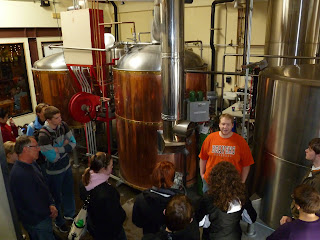
In Klamath Falls, we also got to see perhaps the only geothermally heated brewery, which uses geothermal energy for part of the fermenting process. The students tell me the root beer is excellent! Thanks to my father, Ken Hay, for this image. He and his coworker, John Bellon, are superintendents of city parks in Klamath Falls. They spoke with us about challenges in getting funding for municipal usage of geothermal energy and insulating the trees from geothermally heated sidewalks (otherwise they might bloom in the winter).
 The students wish there was an exercise room on the train. Instead, they take the long stop opportunity in San Jose to catch some sun and get activity.
  Here, Sarah relaxes in the Parlor Car and watches the scenery near San Francisco.
 The group found wi-fi and games in the Parlor Car also. Last night we were served chocolate when we got on the train; today, sparkling cider!
 There was much excitement (and I mean super hyper, getting in touch with their child-sides!) as the train pulled into the Klamath Falls station. Most of the students have never traveled on the train via "sleeper car" before. As soon as we got on the train, they were out like a light (well most of them). A gentleman named Alan who is on the train with us (and a former teacher) says that he loves the "life" my students bring to the train. After conversing with some of them, he told me they are wonderful people.
Geothermal Energy
 Thanks to Anders, I can now access the internet from here in the Parlor Car on the Amtrak Coast Starlight. Here is Anders waiting for the train. We had a very long day and a very late night, due to a late train. We were all exhausted and ready to see our "sleeper cars." Now we are on our way to southern California.
 Yesterday, Engineer Toni Boyd gave us a tour the geothermal plant at Klamath Falls, Oregon, where they use geothermal for heat mostly but also power and a novel usage: snowmelt off sidewalks and roadways! Thanks to Andy and Randy for the tour of the Heat Exchange plant and to Dale for explaining the snowmelt installation process.
 Here, we walk through a tight tunnel to see the geothermal lines.
 We have visited many train stations; here is the group waiting at Albany. We have conquered several set backs including lost luggage, late trains, van rentals not where they were supposed to be, and name mix ups on tickets. Thanks to quick thinking and organization, each challenge is overcome.


 Somewhere between Portland Union Station and Albany, a student's luggage was lost.Fortunately, the luggage was returned to us the next day. Now in Corvallis, the tour continues with a study of nuclear power and ocean wave energy.
 Yesterday, a professor spoke with us about nuclear physics. Afterwards, he said that our group was one of the most
enjoyable, inquisitive groups he has ever given a tour to! I'm very proud of their hard work and positive attitudes. They ask great questions.

Today, we saw a Tsunami Research Lab and toured a wave energy facility. The above photo shows the group watching a simulated Tsunami wave traverse the deep wave tank. The crash of the wave was so loud I jumped.
Later, we saw a prototype of a new energy-harnessing buoy made to harness the up and down mechanical energy of ocean waves and convert it to electrical energy via electromagnetic induction. The photo shows students next to a buoy, this is the very small version. The bronze wrap contains a magnet and the grey rod contains a coil of wire; the rod would be attached to the sea floor and the wrap would float on the surface. With the engineer, we discussed the challenges of this technology and how it affects the environment, fishing communities and marine life.
Nuclear Myths
Myth #1: Is nuclear power expensive?
Yes, The start up cost to commission and build a nuclear reactor is pretty high when compared to the cost of hydropower and coal. But when you compare it to the price of oil and gas, it is quite cheap. I think that in the long run nuclear will be one of the ways to get electricity, possibly to go with electric cars instead of paying $3-5 a gallon for gas. Plus, we will not be contributing to atmospheric pollution because nuclear does not directly emit CO2 into the atmosphere.
Myth #2: Nuclear power is dangerous.
Busted. Nuclear power is just as dangerous as driving down the highway. The modern reactors are built with strict regulations and the chances of them having a "accident" is highly unlikely. Also the CO2 that comes from coal power plants exposes more people to radiation than a nuclear power plant and its waste. The radioactive waste that comes from nuclear power plants is in a solid state and watched. CO2 on the other hand is in the atmosphere, thus exposing far more people to radioactivity.
Yes, The start up cost to commission and build a nuclear reactor is pretty high when compared to the cost of hydropower and coal. But when you compare it to the price of oil and gas, it is quite cheap. I think that in the long run nuclear will be one of the ways to get electricity, possibly to go with electric cars instead of paying $3-5 a gallon for gas. Plus, we will not be contributing to atmospheric pollution because nuclear does not directly emit CO2 into the atmosphere.
Myth #2: Nuclear power is dangerous.
Busted. Nuclear power is just as dangerous as driving down the highway. The modern reactors are built with strict regulations and the chances of them having a "accident" is highly unlikely. Also the CO2 that comes from coal power plants exposes more people to radiation than a nuclear power plant and its waste. The radioactive waste that comes from nuclear power plants is in a solid state and watched. CO2 on the other hand is in the atmosphere, thus exposing far more people to radioactivity.
Myths Busted!
So this is a tad bit late, I made this video a couple days ago while exploring wind farms with Chelsey, my PLU Mythbuster of the day. For the rest of the trip I am going to try and find the truths behind rumors and myths about renewable energy, and this is the starting video, busting the myths about wind power!
If there are any myths your would like me to find the truth behind please comment below and I will do my best to answer. (I think that is possible with blogger).
Nuclear Energy
Today we walked for about 45 minutes from our hotel to the Radiation Center at Oregon State. Here, we got to see their nuclear reactor and even what Uranium looks like. Our tour guide helped us understand how a nuclear reactor works and the differences between reactor designs used around the world along with the uses of a research reactor (the one at Oregon State) and a "power"-reactor.
Wind farm outside of Maryhill, WA
The geology students decided to head east to try and and get out of the rain, and I tagged along.
Energy in Rain?
It's Raining hard
from more than one place
my nose is dripping
and the clouds are holding pace.
The rain is coming down hard here in Cascade Locks and all I can think about is potential energy and spinning turbines. Maybe one day we will funnel a cloud and power this very hotel with the falling water. That dam tour sure gave me a lot of ideas about energy from falling stuff. I still have the image of an electric car with a giant pool-sized tank of water surmounting it and a spinning turbine providing electricity. Imagine! No carbon footprint, just the hundreds of gallons of water pouring onto the car behind you as you race down the freeway.
Bridge of the Gods - Cascade Locks, Oregon
 Spanning over the Columbia River, the Bridge of the Gods connects Oregon and Washington. Scientists speculate that at one point there used to be a natural stone bridge in the area created by a giant landslide. Some say that the Cascade rapids are remnants of the fallen stone bridge. Native American lore tells of two brothers, on opposite sides of the Columbia, fighting over the same woman. Each fought by hurling rocks and stomping so hard that eventually the stone bridge collapsed into the river. Their father, angered by their fighting, turned the brothers into Mount Adams and Mount Hood as punishment. The woman became Mount St. Helens and would occasionally blow her top in grief. The modern Bridge of the Gods is a man-made steel bridge which takes its name after the tale. For the two nights that the group gets to stay in Cascade Locks, I am lucky enough to have such a great view from my window!
100% Rain in the Land of Waterfalls
Columbia River Gorge, Wahkeena Falls

We are back to the hotel after being drenched! Today, our group split up. Some drove east with Dr. Davis to seek dry land and windmills. A few brave water-lovers drove west with me to hike the glorious waterfalls of Columbia River Gorge. Our first attempt to get to the famous Multnomah falls ended in a no-pass of the walkway, it was flooded out. The water in my camera lens speaks of the rest of our adventure.
 We had to drive the long way around due to landslides. The trails we were considering hiking were closed due to mudslides. When we got to the visitor center and asked a park ranger what she suggested doing today she said, "curl up with a good book." They are calling this a "flood day."
 In spite of the heavy rain, we still thought the area was beautiful, lush forested ravines covered in a dense fog. Here, John and Marta stand in the spray of a waterfall. What's a little more water when you're already soaked?
 On a normal day, Multnomah Falls flows a volume of 75 cubic feet per second. Today, the volume was 500 cubic feet per second! The waterfall is 620 feet (we noted these numbers for a later calculation of power output). A worker at the lodge said she had never seen the falls this heavy in all her years working there.

What an adventure! Back at the hotel, we are taking the Park Ranger's advice and curling up with our books.
Inside a hydroelectric dam
 And these are only some of the generators! For scale, note that the windows on top are people sized.
 It was agreed that a pacific northwest day filled with fog and pouring rain holds a special beauty for us PLU folks.
While conversing with students on the train, I learned that one of them is taking the energy course because she feels a sense of responsibility to her planet. She wants to become aware of the science, environmental and social aspects of how we use Earth's resources. Students like this one, who understand the complexities of physics applications, have an optimistic view of our energy future.